 By Olivia Wilson
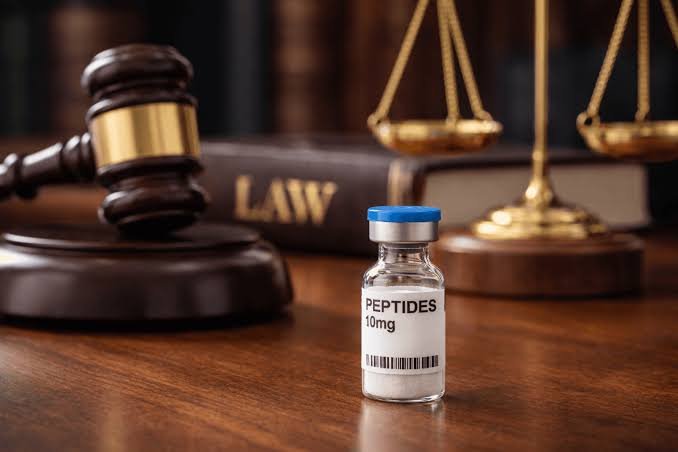
 Yes, many peptides are legal in the United States, but the answer depends on the specific peptide, how it is marketed, and what it is used for. ‘Peptide’ is a scientific description, not a single legal category. Some peptide medicines are approved by the U.S. Food and Drug Administration (FDA) and can be lawfully prescribed and sold. Others are experimental compounds that have never been approved for human use.
That distinction matters because federal drug law focuses on intended use, approval status, manufacturing, labeling, and distribution. A peptide being available on a website does not automatically mean it is approved or lawfully marketed for people to inject or consume.
Are FDA-Approved Peptide Drugs Legal?
Yes. Several peptide-based medicines have FDA approval and are legally available under the rules that apply to the particular drug. Examples include medicines containing semaglutide, liraglutide, glucagon, and teriparatide. Depending on the product, a prescription may be required.
FDA approval applies to a specific drug product and its approved uses. It does not mean that every product containing a similarly named peptide, or every version sold online, is automatically an approved medicine.
What About BPC-157 and Other Research Peptides?
Many peptides promoted for bodybuilding, injury recovery, anti-aging, weight loss, or performance enhancement are not FDA-approved drugs. Examples commonly discussed online include BPC-157, CJC-1295, TB-500, MOTS-C, ipamorelin, and similar compounds.
Their regulatory status is not identical and can change. However, lack of FDA approval is a major legal distinction. A company that markets an unapproved peptide as a treatment, or as a product intended to affect the structure or function of the human body, may be marketing an unapproved drug in violation of the Federal Food, Drug, and Cosmetic Act.
Does “Research Use Only” Make a Peptide Legal?
Not automatically. A chemical or biological material may be supplied for genuine laboratory research. But putting ‘research use only’ or ‘not for human consumption’ on a label does not create a loophole when the surrounding marketing shows that the product is actually intended for people to use.
FDA has repeatedly taken enforcement action on this issue. In 2026, the agency issued warning letters to multiple peptide sellers whose products carried research labels while their websites contained claims or other evidence of intended human use. FDA treated those products as unapproved new drugs.
Are Compounded Peptides Legal?
Compounded drugs operate under a separate legal framework. Federal law permits certain pharmacies and outsourcing facilities to compound drugs when the requirements of sections 503A or 503B of the Federal Food, Drug, and Cosmetic Act are satisfied. Compounded drugs themselves are not FDA-approved products.
Those rules do not allow pharmacies to compound any peptide without restriction. FDA maintains policies governing which bulk drug substances may qualify and has identified safety concerns with several peptides. During 2026, FDA continued reviewing substances including BPC-157, TB-500, MOTS-C, and Semax for possible use in compounding. Advisory review does not itself make a peptide FDA-approved or generally legal to market as medicine.
Is It Illegal to Buy or Possess Research Peptides?
There is no simple federal rule making possession of every unapproved peptide automatically a criminal offense. The answer depends on the substance and the circumstances. Federal restrictions often focus on manufacturing, introducing unapproved drugs into interstate commerce, misbranding, dispensing, and marketing products for human use without approval.
Online availability should therefore not be treated as proof of legality. State pharmacy laws, prescription rules, import requirements, and laws applying to a particular substance may create additional restrictions.
Are Peptides Legal for Athletes?
Sports rules are separate from ordinary federal drug law. A peptide may have one status under U.S. law and still be prohibited by a sports governing body. Competitive athletes can be subject to anti-doping rules covering certain peptide hormones, growth factors, and related substances.
The Bottom Line
Peptides are not universally legal or illegal in the United States. FDA-approved peptide medicines can be lawfully prescribed and sold under applicable rules. Many experimental peptides sold online are not FDA-approved for human use, and marketing them as treatments can violate federal drug law. A ‘research use only’ label does not protect a seller when the product is actually promoted for human use.
Anyone checking a particular peptide should look at that specific product’s FDA approval status, prescription requirements, compounding rules, and applicable state or sports regulations instead of relying on the broad claim that ‘peptides are legal.’